


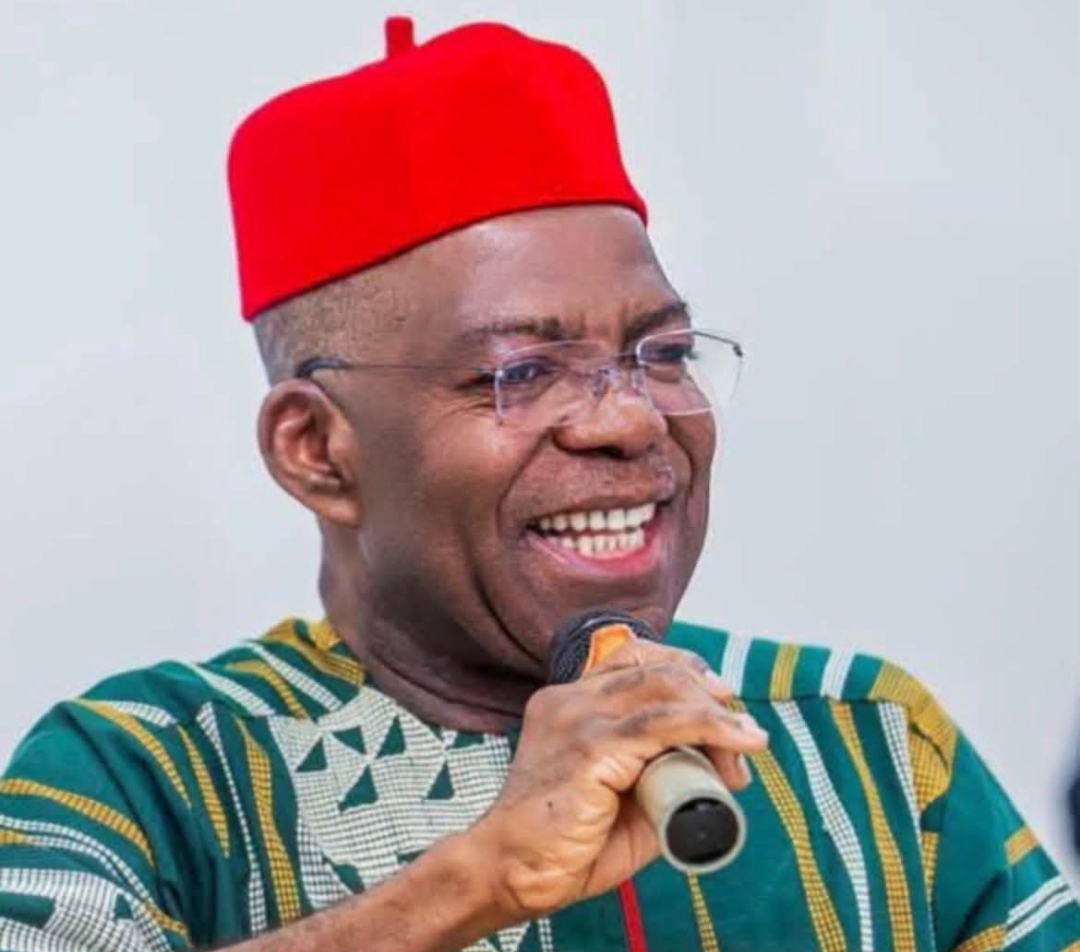
By Emenike Vincent Onyembi (EVO),
There is a common saying in engineering that every bridge, every road, and every building starts to die the day it is finished. From the day a project is opened and called done, nature, time, and traffic begin their quiet and steady work of destruction.
The question that separates great governments from governments people forget is not only how much they can build. It is also how honestly they understand that what has already been built must be kept working. This idea seems to guide Gov. Alex C. Otti of Abia State. And it is exactly why he is facing criticism. In a political culture where new buildings make better campaign photos than road repair crews, his approach was always going to attract attack. Opposition politicians say he is wasting money by repaving some of the old roads that past governments already built. They say he should send that money to other projects or to roads that have never been touched. They also criticize his plan to build a new Governor’s Office and residence instead of using the one his predecessor left behind.
These are not completely unreasonable questions. But they deserve honest answers based on facts. When we look at them carefully, the answers strongly support what Governor Otti is doing on road repair. Let us start with the most basic question. Can a road that has mostly failed, with hundreds of potholes, simply be “managed” without repaving, as the opposition suggests? The answer, backed by many years of transport research, is a firm no. At least not for long, and not cheaply. The South African National Roads Agency (SANRAL) has estimated that repair costs rise to six times maintenance costs after three years of neglect. They rise to eighteen times maintenance costs after five years of neglect. This finding from one of Africa’s most advanced road management bodies shows a truth about roads that applies everywhere. According to analysis from the Asian Development Bank, for every extra dollar a developing country spends on road maintenance, road users save three dollars. A World Bank report also found that each dollar spent on patching saves between $1.40 and $44 in running costs each year. Read that again. Every naira spent on maintaining a road today can save up to forty four naira in vehicle repairs, fuel costs, accident losses, and harm to the economy later. The opposition’s argument that maintenance money should be sent elsewhere ignores this extra saving completely. The World Bank itself found in its study of developing countries that road maintenance spending is often too low. This leads to poor roads and costly road rebuilding. In other words, skipping maintenance does not save money. It delays a much larger bill to the future. Also, research from Indonesia published in ScienceDirect found that road resurfacing and upgrading projects, unlike completely new highway construction, are “shovel ready.” They are better for quick economic impact because they need much less planning and development time. This is not belief. This is road science and money. It is the base on which Governor Otti’s road repair program is built.
To understand why road repair is so central to the Otti administration’s plan, one must understand the condition of Abia’s infrastructure when he was sworn in on May 19, 2023. Abia State had suffered for years from a bad cycle of neglect. Roads were given to contractors, sometimes poorly built, and then left with no maintenance plan. The results were easy to predict. Potholes grew. Drainage systems fell apart. What began as road damage that could be managed became complete road failure. In Aba, the business city and center of manufacturing that drives Abia’s economy, the roads had become a daily nightmare for traders, manufacturers, and commuters. When Otti took office, pensioners were owed money. Civil servants were not paid. Hospitals were in ruins. The state did not have the luxury of starting everything from scratch. It needed an emergency approach. Make steady what exists. Restore what can still be saved. Build new only where nothing useful remains. After taking office, Governor Alex Otti focused on road repair, road rebuilding, and the building of new road networks. This approach has changed Abia’s social and economic life. It has greatly improved the lives of residents and made the state more attractive for business and investment. Importantly, this was done through a mix of targeted new construction and deliberate, systematic maintenance. That is exactly the thirty to seventy idea that his critics now mock. The opposition’s main claim is that repaving roads which past governments already built is wasteful. But this argument only makes sense if someone believes that asphalt lasts forever. It does not. Asphalt pavement has a normal useful life of between ten and twenty years under normal conditions. It lasts even less under Nigeria’s heavy rain, poor drainage, and high commercial truck traffic. Once a road reaches the end of its planned life, resurfacing is not optional pride. It is needed for the road to work.
In Aba, the repair and new asphalt surface of major roads such as Jubilee Road, Queen’s Street, Bata to Salad Market Junction, and Ehi Road have brought back Aba’s old strength as a busy trading center. Traders and commuters now spend less time traveling and have better access to markets. This helps economic activity. These are not improvements only for looks. Restored road surfaces lower the cost of running vehicles. They lower transport fares. They cut delivery times for goods. They reduce accidents. All of these directly affect economic activity in a commercial city like Aba. Beyond local roads, Governor Otti’s administration has worked with the Federal Government on important projects of national value. The Port Harcourt to Aba section of the Port Harcourt to Enugu Expressway is one example of how working together can bring major road benefits. If anyone thinks the Otti administration has focused on road repair instead of new construction, the numbers tell a different story. As of May 2026, Governor Otti said his administration had completed 414 road projects covering 864.12 kilometres across the state in three years. Another 82 road projects measuring about 212 kilometres were still under construction at different stages. The government also kept installing streetlights on major roads and set up a road maintenance framework through its direct labour agency. In May 2024, only one year in office, Otti was already opening road projects. These included the Ossah six lane road, now called Aguiyi Ironsi Boulevard, in Umuahia, as well as University and College roads and Green Avenue in Osisioma. By June 2025, his administration had opened 14 roads and four primary healthcare centres across various local governments in Abia South and Central senatorial zones. This was just one phase of a 55 project opening exercise.
This is not the record of a governor who is only painting old walls. This is the record of someone maintaining what already exists and also building what is needed. The opposition’s criticism, seen in this light, is exposed as anger only when it suits them, not a fair study of government. The opposition’s second main criticism is that Otti left a perfectly good government house built by his predecessor and is now building a new one. This also needs an honest look. When Otti took office, he refused to move into the new Government House at Ogurube Layout, Umuahia, which his predecessor Okezie Ikpeazu was said to have opened before leaving office. He also found the old Governor’s Lodge and Governor’s Office in what he called a very bad state. Otti explained that his predecessor opened an uncompleted building. He said the cost of completing the new government house or repairing the old one was too high for his early administration. He said his administration had drawn an order of what matters most. That order placed road building, payment of salaries, repairing hospitals, helping businesses that were about to fail recover, supporting small and micro businesses, and setting up an industrial park above his personal comfort. His Chief Press Secretary Ukoha Njoku Ukoha confirmed that some contractors brought price offers running into hundreds of millions, and some close to one billion naira, just to repair the Government House. The Governor decided this was not a priority when Abia pensioners were owed money, civil servants were not paid, and hospitals were in ruins. This is not careless spending. This is an order of what matters most. Any responsible manager who inherits a weak system must decide what to fix first. Governor Otti chose to fix things that affect millions of ordinary Abians before fixing his own office.
A media tour of the Ogurube Layout Government House led by the Abia State Commissioner for Information Prince Okey Kanu showed that the building was not plastered in several places. The elevator was not installed. The structure posed safety risks. The Commissioner said the place was not safe to live in and had never been completed to the claimed standard. This puts the opposition’s claim that Otti “abandoned” a working government house in a completely different light. You cannot move into a building that was never completed. The construction of a new Government House and Governor’s Lodge is now going on. The old Aba Governor’s Lodge has been changed into a state of the art building. Far from abandoning public assets, the Otti administration appears to be both building new facilities and using existing ones in new ways. The Ogurube Layout building is said to be turning into a five star hotel that could bring money to the state. This is smart government, not waste. The opposition’s argument, in simple terms, is a very old one. Building new things looks like progress. Maintaining old things looks like standing still. This way of seeing things has caused some of the most expensive road failures in Africa. Across Nigeria and much of Sub Saharan Africa, governments have built roads that turned to gravel within years. This was not because the roads were poorly designed. It was because there was no maintenance plan, no maintenance budget, and no maintenance culture. The World Bank has repeatedly pointed to this as one of Africa’s most lasting infrastructure problems. The pattern is sadly familiar. A government builds a road. It takes photos. It wins applause. It moves on to the next project. Within ten years, the road is unusable. The next government builds another road on the same route, often at a much higher cost. Then the cycle repeats. Governor Otti seems to understand this cycle and is deliberately trying to break it. When he opened 14 roads in one day, he called on residents to protect the newly fixed roads. He stressed that he expects them to take more than a passing interest in making sure the roads are not destroyed by commercial activities or neglect. He is not just opening roads. He is trying to build a maintenance culture. This culture involves government and citizens alike. This is the mature, long term thinking that Abia State has lacked for a long time.
It would not be fair to judge Governor Otti’s performance without noting that this road repair and maintenance idea goes far beyond roads. He has used the same logic of “fix what is broken before building what is new” in many parts of government. Long standing salary and pension debts have been cleared. This has restored spirit among workers and retired workers. Within days of taking office, he declared states of emergency in critical areas including roads, health, sanitation, and security. This showed a clear change from past practices. In health, his government hired 821 healthcare professionals. At least 771 are already on duty. At least 193,000 people have signed up for the Abia State Health Insurance Scheme. A total of 277 Primary Healthcare Centres have been repaired and upgraded across the 184 wards in the state. Of these, 200 were funded by the State Government and 77 were supported by the World Bank. In education, over 300,000 pupils have enrolled. The government is aiming for 500,000 enrolments to sharply reduce the number of out of school children. The government has successfully hired over 9200 teachers so far. On money management, Abia State improved its ranking in budget openness, honesty, and responsibility from 17th position in 2023 to fourth position in 2025. The 2025 budget of ₦750 billion set aside 82% for building projects and 18% for running costs. It set aside 20% for education and 15% for health. Governor Otti stressed that no loans were taken to finance the 2024 budget and all borrowing in 2025 would be for specific projects. This is a government that, whatever its faults, is meeting its duties to workers, maintaining its healthcare infrastructure, maintaining its schools, and maintaining its money discipline. It is doing all this while building new things at a pace that produced 414 completed road projects in three years. Governor Otti once said, in response to critics, “we have always ignored them, and we shall continue to ignore them. We respond with performance.” That is basically the right answer to the opposition’s noise. Politics rewards the showy. It rewards the brand new flyover, the shiny government house, and the ribbon cutting ceremony. Governance, real governance, rewards the plain work of keeping things working. It rewards paying teachers on time, patching the road before it collapses, and fixing the hospital before it fails.
The opposition’s argument that failing roads should be ignored so that new ones can get attention is the argument of people who do not fully grasp the economic effect of maintaining roads. Road management without timely resurfacing is not management. It is delay with consequences. It is the same thinking that allowed Abia’s roads, hospitals, schools, and finances to fall apart over many years of leadership that preferred announcements to maintenance. If development were a building, construction would be its foundation. Maintenance would be everything that holds it upright afterward. The foundation alone, without ongoing structural attention, will crack, settle, and eventually bring the whole building down. This is not poetry. It is physics. And it is governance. Governor Otti’s body language that development is 30% building and 70% maintenance may never create the kinds of headline grabbing moments that political rivals can easily attack. But the 70%, which is maintenance, repair, restoration, and long term care, is the part of governance that decides whether the 30% that is newly built will still be standing ten years from now. It is the part that separates states that are transforming from states that are merely performing. Abia has been performing for a long time. Under Governor Otti, there are signs that it may finally be transforming. The roads are being fixed. The hospitals are being staffed. The teachers are being paid. The accounts are being kept honestly. And the man in charge chose to sleep in his own house rather than spend a billion naira repairing a lodge. This is not because he does not deserve comfort. It is because he understands that the people he governs deserve working roads more. That, in the end, is what a maintenance culture is, not just in theory but in practice. Every naira spent on road repair and maintenance saves forty four naira. That is not waste. It is wisdom. And the critics, loud as they are, have only succeeded in “turning logic on its head,” while the roads hold.
©️2026 Emenike Vincent Onyembi (EVO)
Disclaimer: Candid Reporters publishes news, information, sports, opinions, and Interviews. The site includes both reported and edited content. Unmoderated posts and Comments expressed here do not reflect the opinions of Candid Reporters or any employee thereof..
