


The African Women in Agricultural and Research Development(AWARD) in collaboration with International Fund For Agriculture (IFAD) funded Livelihood Improvement Family Enterprises Niger-Delta (LIFE-ND) has held a workshop to identify the gaps in the National Policy on Food and Nutrition in Nigeria.
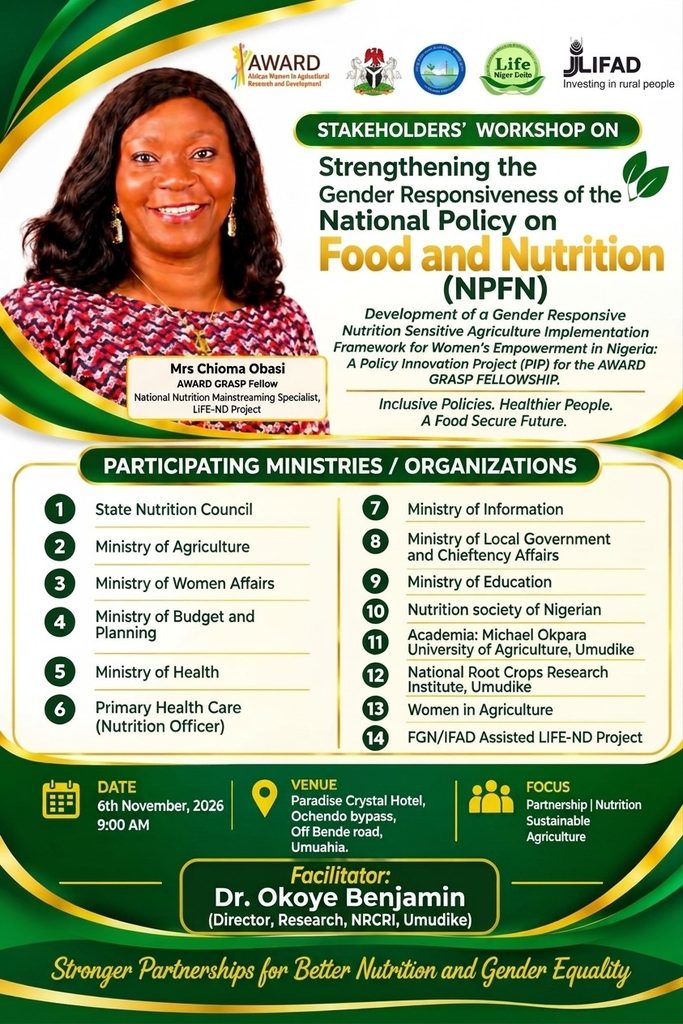
The workshop held on Friday in Umuahia, the Abia State Capital had the theme: Strengthening the Gender Responsiveness of the National Policy on Food and Nutrition.
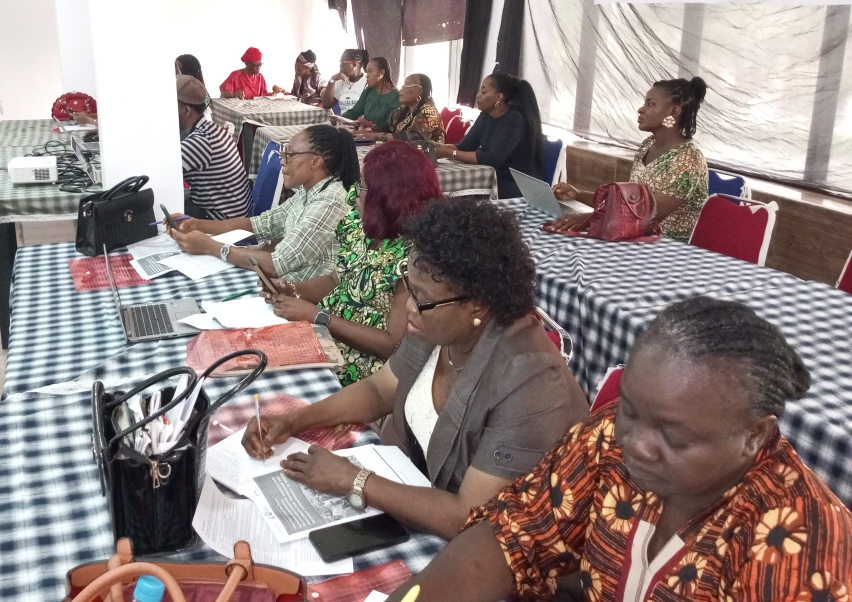
The workshop entertained participants from the Ministry of Budget and planning, the Ministry of Agriculture, Ministry of Finance, Ministry of information, Ministry of Health, National Society of Nutrition, and the Livelihood Improvement Family Enterprises (LIFE-ND) and others.
The workshop which focused on Development of Gender Responsive Nutrition Sensitive Agriculture Implementation Framework for Women’s Empowerment in Nigeria was championed by Mrs. Chioma Obasi, the National nutrition mainstreaming specialist for International Fund For Agriculture (IFAD) funding the Livelihood Improvement Family Enterprises, Niger-Delta (LIFE-ND) and AWARD GRASP fellow.
According to Mrs. Chioma, while addressing newsmen about the workshop said gender responsive budgeting and gender responsive implementation is a critical part of Nigeria’s nutrition policy that requires needed attention.
Mrs. Chioma added that government ministries in Nigeria are now more intentional about having a nutrition arm and it warranted their invitation and participation in the workshop.
Asking more about her mission on the workshop, Mrs. Chioma said she’s fufilling a task on the National Policy on Food and Nutrition by tracing the gender gaps and best way of implementation with a mission to ensure that agricultural programs and policies should be more gender responsive in Nigeria by strengthing the capacity of stakeholders to implement gender responsive programs.
“I looked for the gender gap in the National Policy on Food and Nutrition. I was fortunate to be selected among 50 women in Africa to participate in training program called Gender Responsive Agricultural systems Policy Fellowship, organized by the African Women in Agricultural Research and Development.
“We gathered to celebrate and look at the frame work and see how we can make it better and validate the framework already developed”. Mrs. Obasi said.
The facilitator for the workshop, Dr. Okoye Benjamin Chukwuemka, Director of Research, National Root Crop Research Institute, Umudike, Abia State, while addressing newsmen expressed satisfaction that the gaps identified in the national policy on food and nutrition needs attention and recommendations. He however expressed satisfaction that the federal government of Nigeria has streamlined gender nutrition components into policies.
“It is no more only about food security but now about nutrition and food security. Sometimes you may have the food but no food security, so we match it up together”. Dr. Chukwukwuemeka said.
Dr. Chukwukwuemeka acknowledged that small scale agriculture has substained Nigeria and other countries in the world. He recommended that policies targeted at small scale farmers will go a long way in mitigating food insecurity in Nigeria.
He added that the workshop is a hug success as it is also known as the citizens approach which have involved all stakeholders on a way forward.
“It is called the citizens approach, you need to assemble these stakeholders. Most people are not aware of this policy document, part of it is to scale it down to our various ministries and parastatals so that chief executives will be held accountable for implementation lapses of the budget”. Dr. Chukwukwuemeka said.
Dr. Nkiruka Stella Okonkwo, Co-Founder, LANOF National Council, National Gender Policy on Agrifood Systems Transformation for Nigeria and Its Strategic Plan of Action (2025-2030) also joined the workshop virtually. She encouraged the participants to remain resolute in identifying grey areas that requires attention for effective policy formulation and application.
Damian Oluchukwu, Deputy Director of Nutrition in the Ministry of Budget and Economic Planning, a participant in the workshop while speaking to newsmen about her experience and participation said, she learnt a lot about gender responsive budgeting and it will help a lot in the area of budgeting in their in office.
“The major thing I learnt is that currently, our budgeting is not gender responsive and going forward we need to adopt gender responsive budgeting in the system”. Oluchukwu said.
Umerechi Ofoegbu, the Abia State Nutrition Officer of the Primary Healthcare care Development Agency said lots of policies are targeted towards women only and from the workshop she has seen the need to include other gender.
“I have learnt that nutrition mainstreaming activities are not just for women, from this workshop I have learnt it is important to include other gender”. Umerechi said.
Disclaimer: Candid Reporters publishes news, information, sports, opinions, and Interviews. The site includes both reported and edited content. Unmoderated posts and Comments expressed here do not reflect the opinions of Candid Reporters or any employee thereof..
