


As Part 3 of the Series preceding Captain August Okpe’s birthday in August 2026, we deem it proper and befitting to bring you face to face with the aviation maestro. Calm and composed, the Great Eagle of Nigerian Skies takes us through four decades of his illustrious and hectic flying career as both military and civil pilot, 1963-1999. Read on, please:
Question: In 2009 you published a 602-page air war military history book titled “The Last Flight.” In this book you stated you and your colleagues joined Nigerian Air Force in 1962 when it was established. Since your retirement have you been in contact with your colleagues?
Answer: Yes. But till two years ago when the last of them died.
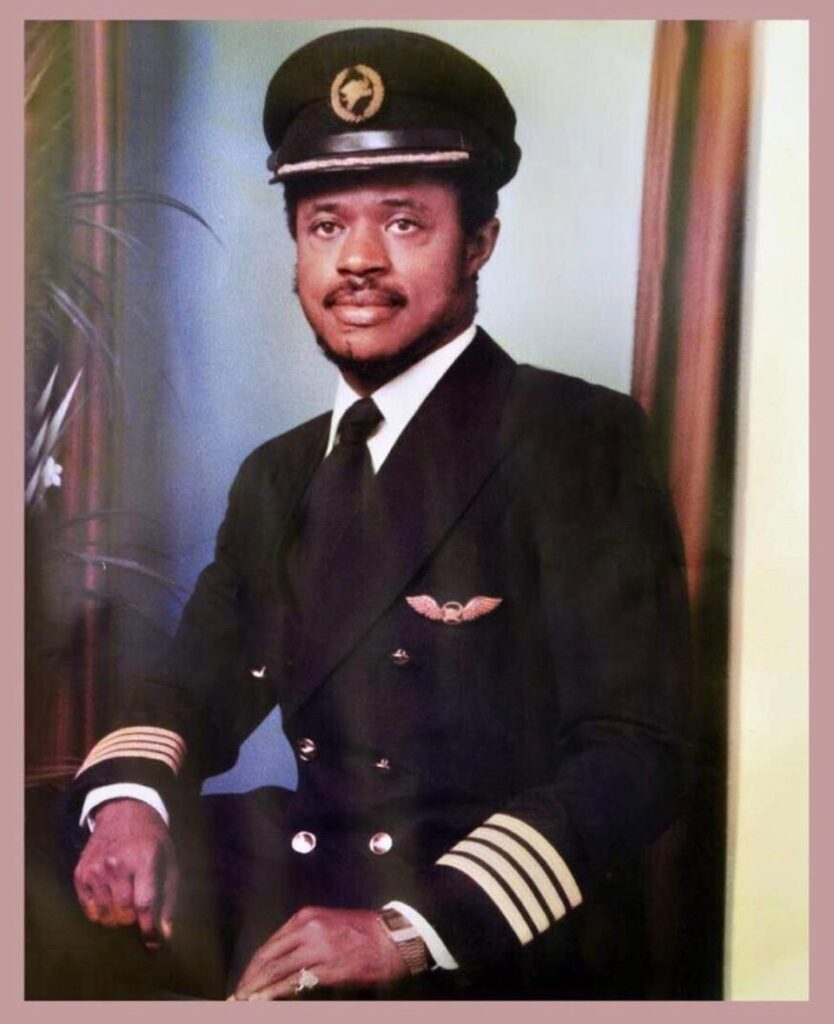
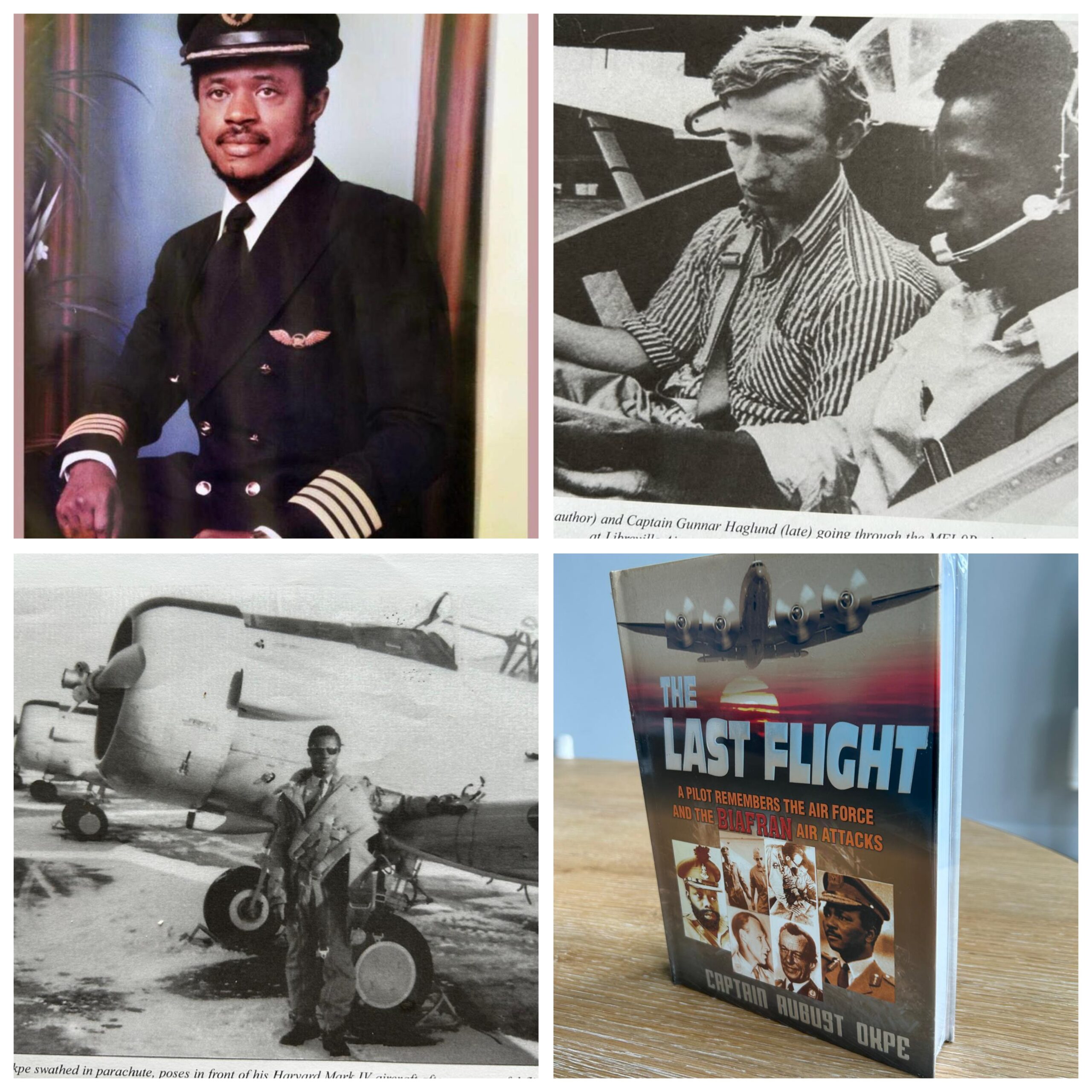
PHOTO: Captain August Okpe, Deputy Chief Pilot Nigeria Airways.
Question: That makes you the last surviving most senior pioneer pilot of Nigerian Air Force.
Answer: Precisely.
Question: What motivated you to join the military?
Answer: I have always admired a disciplined and regimented environment or organization. Also, I enjoyed being a Boy Scout in primary school because of the smart uniform we were all decked out in. Given that I loved to fly, why not have the three of them for the price of one? And that was the Air Force.
Question: Were your parents supportive of your decision to join Nigerian Air Force?
Answer: Yes and no. My father fully supported me but not my lovely mother. On the day I was to board a plane to Canada for my flight training, my mother was heartbroken. She cried all the way from Ikeja to the international airport given that she was told air force pilots didn’t live long. She could have stopped me if it were in her powers. To demonstrate her dislike for my job as combat pilot, let me repeat here a discussion that took place between me and my mother.
When I returned home following the successful completion of my flight training, I was given a huge reception in my hometown. I overhead my mother telling her friends that I deceived her. That she had thought she was down with malaria without knowing I crept into her womb as foetus. My mother was past her menopause and pregnancy was the last thing on her mind. And so she continued to take traditional medicine but her condition only worsened. Then she increased the dosage to clear the stubborn sickness only for her health to further deteriorate. At last, she consulted a medical doctor who shocked her with the news she was expecting. I was born when my mother was 53.
After the celebration, I casually commented to mother that I was lucky the traditional and orthodox medicines she took did not affect the foetus in her womb. Gently shaking her head, she said her medications did not affect the physical development of the foetus but its brain. Since I was that foetus, I then asked how. Her response was that no normal human being whose brain was intact would agree to train to become a pilot. She never really liked my profession as combat pilot.
Question: Captain Okpe, correct me if I’m wrong: You did your flight trainings at the prestigious Central Officers School, Royal Canadian Air Force, Centralia, Ontario; and the Royal Canadian Air Force Flight School, Penhold, Alberta, Canada. To become a Military Instructor Pilot, you trained at the School of Instructional Technique, Royal Canadian Air Force, Clinton, Ontario; the Royal Canadian Air Force Flight Instructors School, Moose-Jaw, Saskatchewan, Canada; the United States Air Force Flight Safety Centre, Valdosta, Georgia; and the University of Southern California, (College of Aerospace Science), Los Angeles, Calif., USA. Is my record correct?
Answer: Your record is correct.
Question: Then after a military tribunal dismissed you from Nigeria Air Force in 1970 because you fought for Biafra during the Nigeria/Biafra war that lasted from 1967-1970, you obtained your Airline Transport Certification at the Acme School of Aeronautics, Fort Worth, Texas. That made you the first Nigerian Pilot to concurrently hold the US Military Pilot Licence and Civil Airline Transport Pilot Licence. You later added the Licence of Switzerland to your portfolio. While flying for Nigeria Airways, you were sent for training at the Fokker Aviation Flight School, Amsterdam, Holland; the Boeing Airplane Flight School, Seattle, Washington, USA; the Airbus Flight School, Toulouse, France; and the British Airways Flight School, Gatwick, UK. You also attended Cranfield University, Bedfordshire, UK. Am I correct?
Answer: You’re correct.
Question: Before the Nigeria/Biafra War, you attained high offices and professional excellence as Instructor Pilot and Staff Officer Operations, Nigerian Air Force Headquarters, Marina, Lagos. You were also the First Air Accident Investigator and Chief of Flight Safety of Nigerian Air Force. How did you escape being killed as an Igbo officer following the 29th July 1966 counter-coup that toppled General JTU Aguiyi-Ironsi?
Answer: I was posted to Kaduna in northern Nigeria when the Igbo pogrom began. We were flown out of Kaduna to Jos by our fellow pilot officers happy to be of help. Those flown to Jos with me were Captain Emeka Omeruah, Captain Elendu Ukeje and Captain Goddy Ezeilo. Then I escaped from Jos hiding inside the water tank of a spoilt locomotives engine towed from Jos to Enugu. Omeruah was in the water tank with me.
Question: You were Head of Operations of Biafran Airports Board. What was the overhead function of the board?
Answer: The Biafran Airports Board had Mr. Clement Onyemelukwe as Chairman; Dr Alex Ekwueme was Head of Planning and Mr. Chris Efobi as Head of Administration. I served as Head of Operations to the board. We built Uga and Okija Airports on record time. A third airport at Ntigha was in gestation when the war ended.
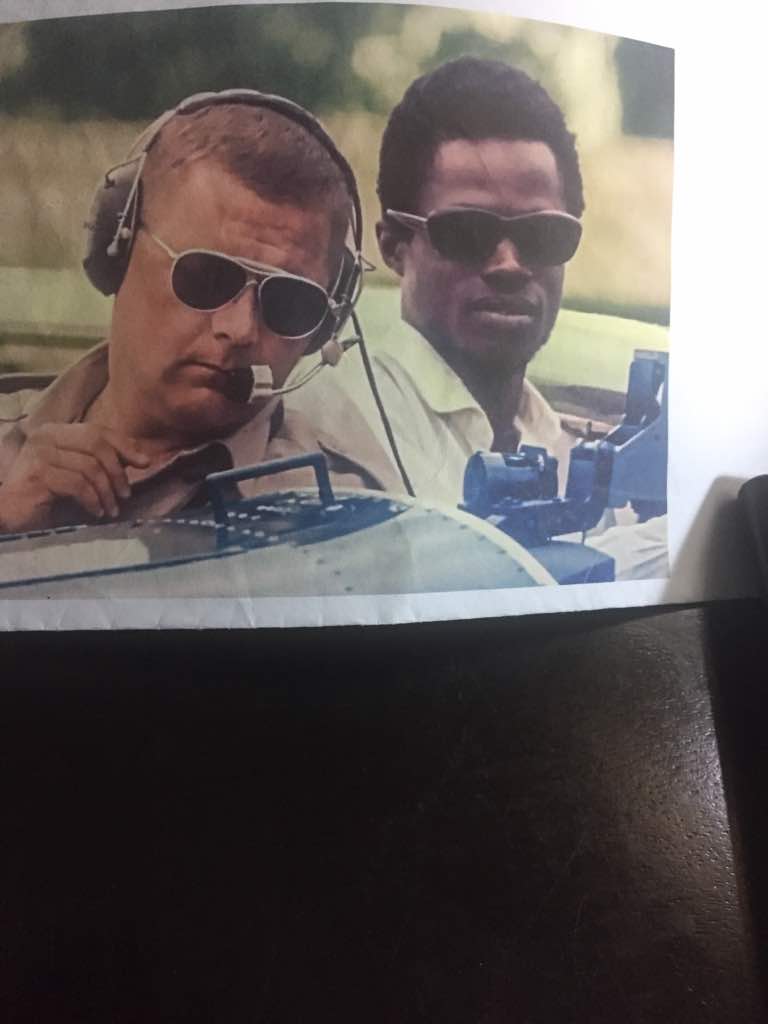
PHOTO: Captains Okpe and Martin Lang in the cockpit of Biafran Air Force plane, 1969.
Question: Uli Airport was codenamed Annabel. Why Annabel?
Answer: The name Annabel was a befitting epithet that conjured up a beguiling woman of irresistible beauty. It became the metaphoric allure Uli Airport had for enemy pilots hooked on destroying her at all cost. Night after night they hovered over her randomly dropping bombs with the hope of hitting and subduing her. But the beautiful one refused to yield.
Question: As Biafran Chief Pilot and Head of Flight Operations, you made a test flight into Annabel Airport when it was completed. Why did you approve the facility as viable for Joint User Airport System?
Answer: Annabel satisfied the high standard set for it by Biafran Airports Board and so I gave it pass mark. Later events proved me right as it became the second busiest airport in the world after the O’Hare International Airport in Chicago, the US.
Question: Harold Wilson, the British Prime Minister, openly declared “Annabel must be destroyed.” Why was it difficult for Nigeria pilots to bomb Annabel out of existence?
Answer: Annabel Airport was a byword for deception. It thrived on efficiency and camouflage making it extremely difficult to spot at night when it operated. In daytime it was without activities. No structure existed near the airport and its control tower was underground.
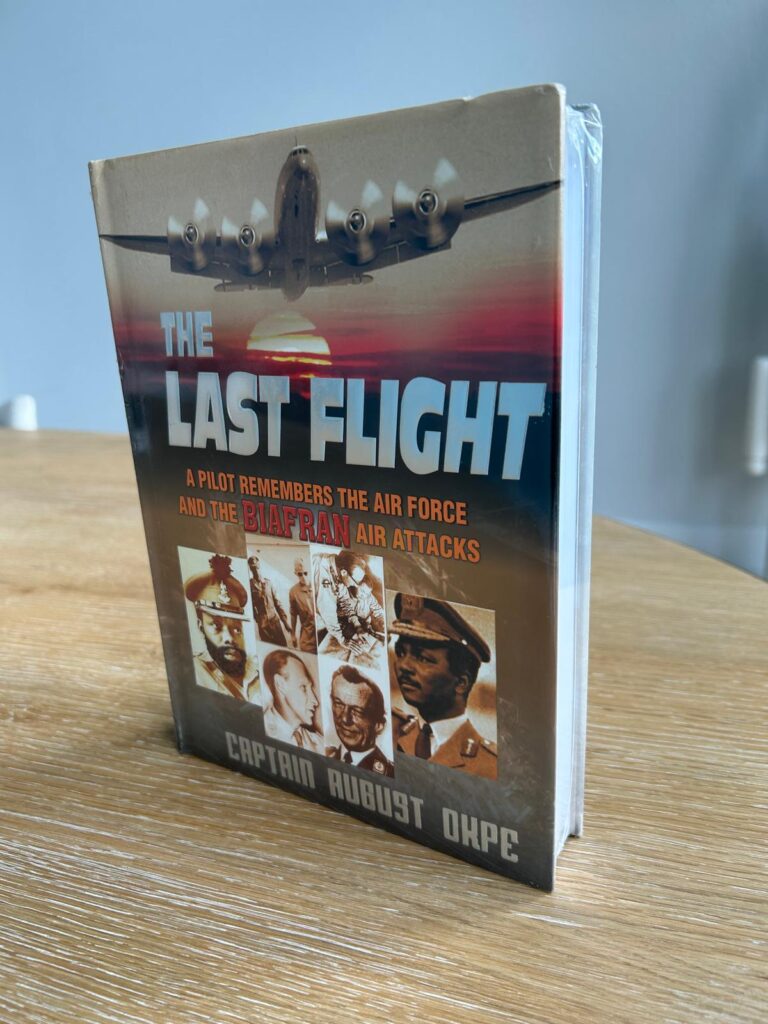
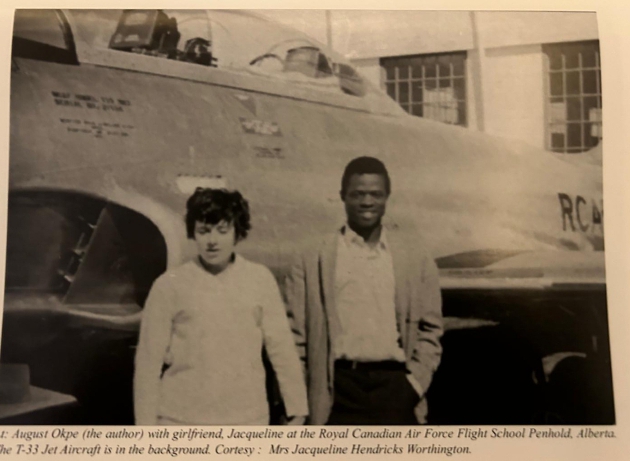
PHOTO: Captain August Okpe’s 602-page masterpiece, “The Last Flight,” is the only air warfare military history book written by a combat pilot on the Nigeria/Biafra War, 1967-1970.
Question: Biafran pilots who operated from Annabel Airport were called “Darlings of Annabel” or “Biafran Babies.” The Swedish noble man called Count Carl Gustav von Rosen was one of them. What manner of man was he?
Answer: Count Carl Gustav von Rosen was a great African hero who risked comfort and fortune saving lives.
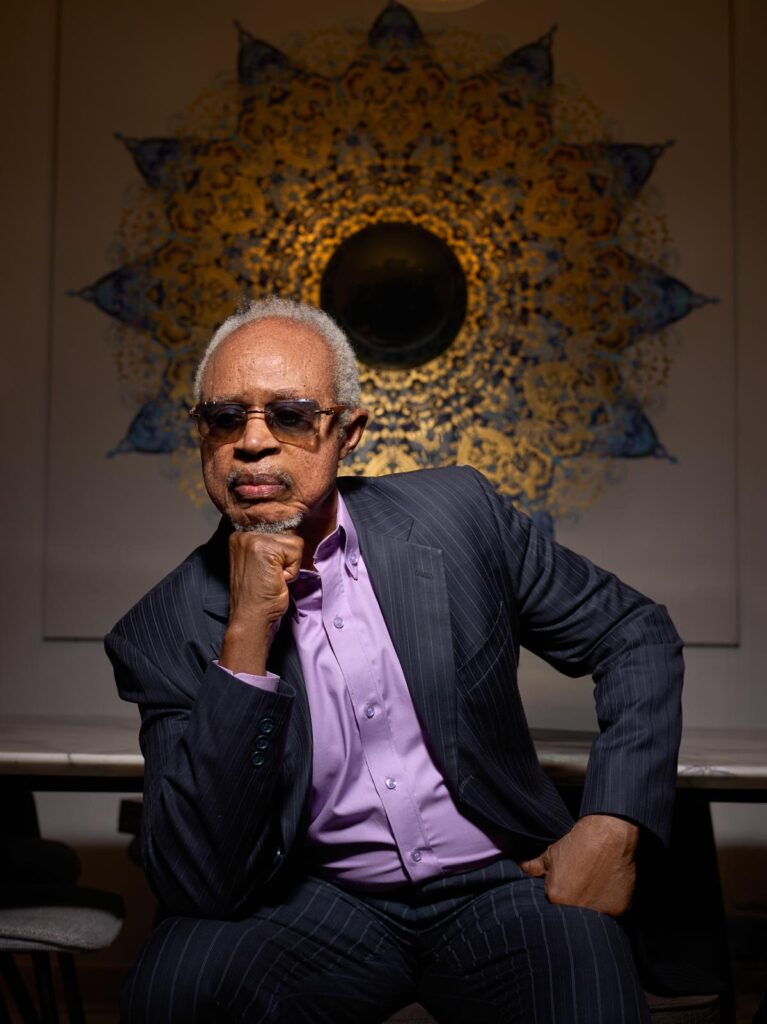
PHOTO: Captain August Okpe in a meditative mood, Lagos, Nigeria, 04 Aug. 2026.
Question: At a point you were the Presidential Pilot attached to Biafran Head of State, General Chukwuemeka Odumegwu-Ojukwu. That was a position of trust. Why did he pick you for such office?
Answer: I was the most senior and experienced military pilot around. It was only logical I should fly him.
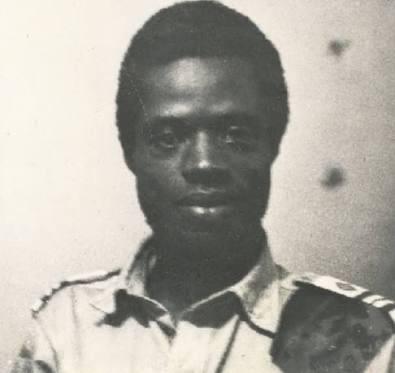
PHOTO: Squadron Leader August Okpe as Biafran Chief Pilot and Head of Flight Operations; Commander, Tactical Air Command Biafra (circa 1969).
Question: You were in Enugu when the first plane hijack took place on 27th April 1967; even before the declaration of Biafran Republic. Why did Lt. Col. Ojukwu resort to such extreme measure?
Answer: You can quote me: Ojukwu did not authorize the snatch as Military Intelligence kept him in the dark. He was only informed when the operatives successfully hijacked the Nigeria Airways plane and were enroute to Enugu. The Nigerian government under General Yakubu Gowon isolated and embargoed the Eastern Region where then Lt Col Ojukwu was governor. The hijack was a response to the economic and financial starvation of Ojukwu’s Eastern Region. The hijacked plane in question was also our common wealth.
Question: You survived the air war but many of your colleagues were killed. What was responsible for the heavy casualty registered among combat pilots of the Tactical Air Command you headed?
Answer: The Tactical Air Command consisted of two cadres of pilots. The first group comprised of former Nigeria Air Force pilots trained in air warfare. The second group consisted of former Nigeria Airways commercial pilots retrained for military duties. The heavy casualty you talked about was prevalent among the latter. Those of us trained as military pilots did exceptionally well and also survived the war.
Question: Give us a glimpse of your typical day as combat pilot during the war?
Answer: My typical day began with a military courier bringing me Mission Order. I must sign, collect and open it myself since it contained targets to be destroyed. As Commander of the Tactical Air Command of Biafran Air Force, I received my orders direct from Defence Operations located inside State House. This security measure was necessary because Biafran Head of State, General Chukwuemeka Odumegwu-Ojukwu, feared sabotage. I then plotted my flight plan using maps and charts. An eerie silence descended on the house as I drew lines. My family knew I would soon be air borne to face anti-aircraft guns.
As I plotted my flight plan my beautiful wife, Patsy, quietly played with our twin daughters with her head bowed. Years after the war, my mother in-law, Bessie, who lived with us, told me the arrival of the courier man threw her into panic and instant dysentery. She dreaded the prospect of her daughter becoming young widow under war condition. The death of every pilot left a big vacuum in the lives of those he left behind.

PHOTO: Mrs Patsy Okpe, wife.
When Captain Ernest Ike crashed and died in the DC. 3 airplane he was flying, we sent a delegation of pilots to break the sad news to his family. His distraught mother rolled on the floor screaming we had killed her husband. Her soulful dirge, or would I say Igbo Spiritual, to her departed son was so unnerving that the female officer in the delegation started crying right there on the floor beside the bereaved. The grieving mother’s apostrophe to her dead son, at the metaphysical level, was also directed at every combat pilot present. One fateful flight awaited every pilot.
A military vehicle would pick me from my house direct to the airport where my plane was waiting. I took off immediately after pre-flight inspection not knowing what awaited me in the skies above. The cockpit could be your funeral pyre if hit by one of the shells angrily hauled at you from the dense jungle below.
Question: Throughout the war, you made trips to Gabon with Count Carl Gustav von Rosen. What were your missions in Gabon?
Answer: The Republic of Gabon hosted the offshore office of the Tactical Air Command I headed. That was where we went to assemble our military aircraft and also train our pilots.
Question: How were Biafran aircraft engineers able to keep your air planes worthy?
Answer: We got our spare parts from Sweden, France and Portugal with which our engineers kept us flying. Funny enough, Sweden that made the air planes we flew also made the Swedish Bofors anti-aircraft guns in the hands of Nigerian troops used in shooting our planes out of the skies.
Question: You flew one of Biafran last hostile flights in January 1970, just days to the end of the war. At what point did it dawn on you it was all over?
Answer: I flew my last hostile flight in a two-plane formation. I piloted one plane while the other was operated by Captain Willy Murray Bruce. From the air we saw long columns of enemy vehicles everywhere and I immediately concluded the war was over. I told Willy not to open fire as the enemy did not even bother to shoot at us. What was the need firing when enemy troops were far too many; not when they completely ignored us. We returned to base and that was my last hostile flight as Biafran combat pilot.
Question: Where were you on 15th January 1970 when Biafra capitulated?
Answer: I was at home with my young wife and children waiting for the inevitable.
Question: You could have escaped Biafra with your family on 15th January 1970 or earlier. What informed your decision to stay?
Answer: I had no reason flying out of Biafra. No. I was a professional pilot and not a political appointee. I never committed war crimes and was not afraid of trial. I only fired at economic and military installations. I never shot at civilians; unlike the Egyptian pilots working for Nigeria. My operation instruction was to wear down Nigerian resolve to prosecute the war and I did that to the very best of my ability.
Question: After the war, a Military Tribunal set up by Nigerian Head of State, General Yakubu Gowon, dismissed you from Nigerian Air Force but some of your colleagues who were originally Nigerian Air Force officers were reabsorbed. Why was your case different?
Answer: I featured prominently in the prosecution of the war as the Chief Pilot of Biafra. Captain Elendu Ukeje and I were the most senior Nigerian Air Force pilots and they saw to it that we were not recalled. Captain Ukeje also fought bravely in the air campaign against Nigeria. I was a well decorated combat pilot and winner of Biafran Military Cross; and other awards. If I destroyed a lot of installations from the air, it simply means I was a good combat pilot. The Igbo would say, if Amadioha the Thunder god could cut in two the mighty iroko tree with its bare hands, imagine the havoc it would wreck if given a machete? I destroyed so much military targets with my air plane, imagine the havoc I would have caused given one of those MiG fighter jets at the disposal of Egyptian pilots.
Question: What happened after your dismissal from Nigerian Air Force?
Answer: I was a free man with family to support. My efforts to travel overseas for the singular purpose of converting to civil aviation was frustrated as I was denied permission to leave the country. I was deemed a security risk not to be let out of sight by Nigerian intelligence. I joined matters with the authorities and they finally let me travel. I went to Acme School of Aeronautics and other civil aviation institutes; and sorted out my papers. When I returned to Nigeria, I began flying for Nigeria Airways where I rose through the ranks to become Deputy Chief Pilot. My background as military pilot aided my rapid promotions.
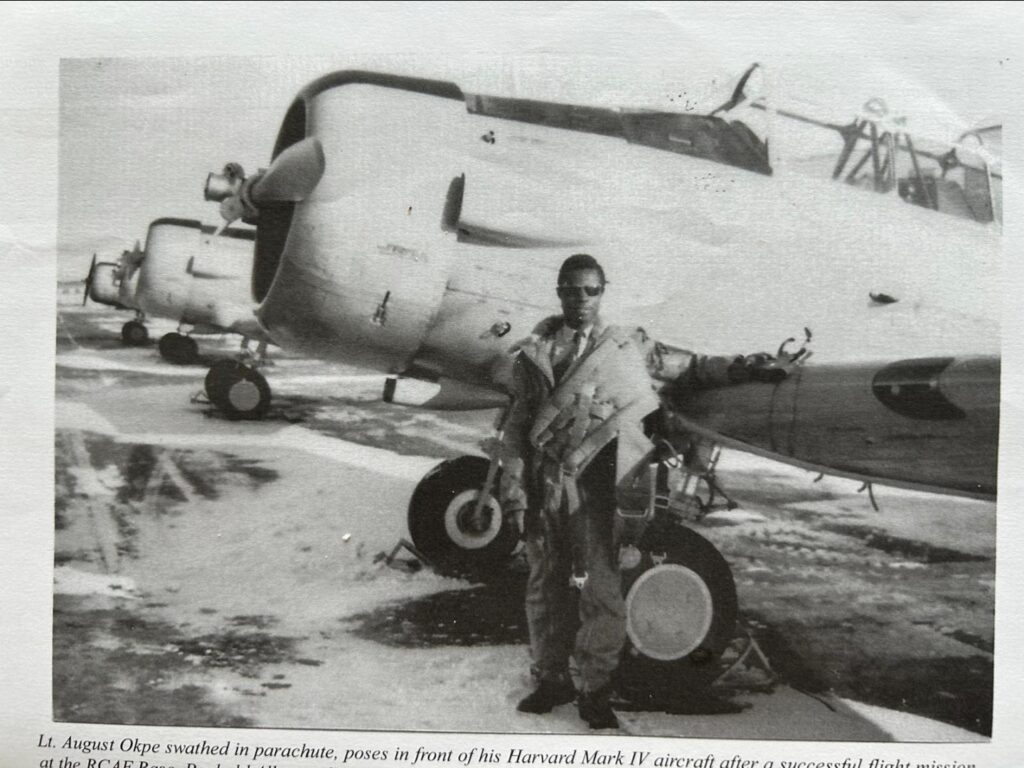
PHOTO:Captain August Okpe swathed in parachute next to his Harvard Mark IV aircraft, Canada, 1964.
Question: Do you have regrets fighting in that war?
Answer: Nigerians should regret fighting that war. No war is a good war, for the aggressor as well as the victim. I regret it and expect my compatriots to also regret it.
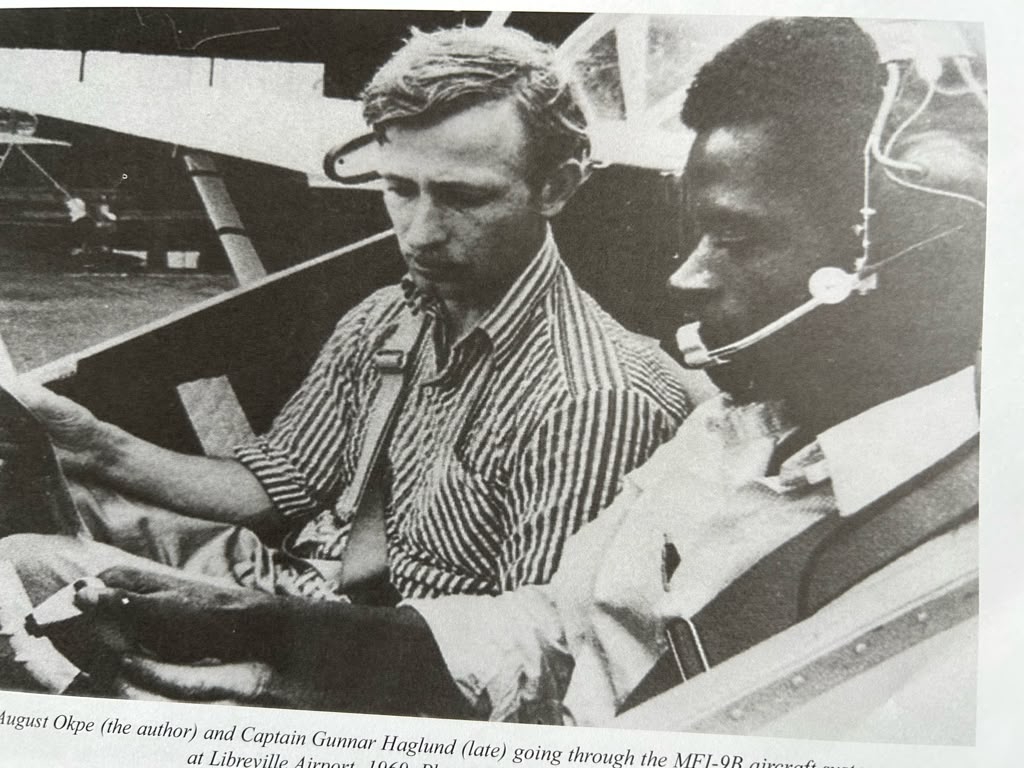
PHOTO: Captain August Okpe at Libreville Airport, Gabon, while preparing to attack Port Harcourt, 1969.
Question: How did you feel when President Olusegun Obasanjo granted you Presidential Pardon in 2006?
Answer: I was indifferent. Nigeria fought us and removed me from Nigeria Air Force. If it was a war between brothers, why was I dismissed?
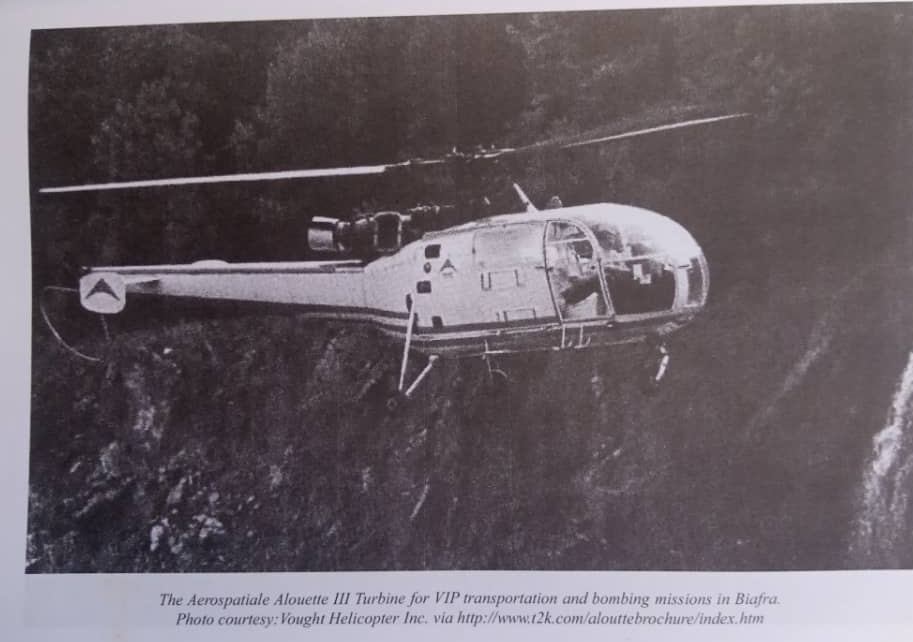
PHOTO: Versatile Captain Okpe, a jet fighter pilot, also flew Lt. Col. Chukwuemeka Odumegwu-Ojukwu in Alloutte III turbine helicopter antecedent to Biafran Declaration.
Question: You married Lady Patsy Okpe in July 1967 during the war. We want to Know Captain August Okpe the family man.
Answer: I just dropped General Ojukwu and went to relax with Captain Andrew Nwankwo who was late General Ironsi’s ADC. This beautiful girl in the company of Nwankwo’s girlfriend told me her name was Patsy and that was how I met my wife. From then I never took my eyes off her and we eventually got married in July 1967.
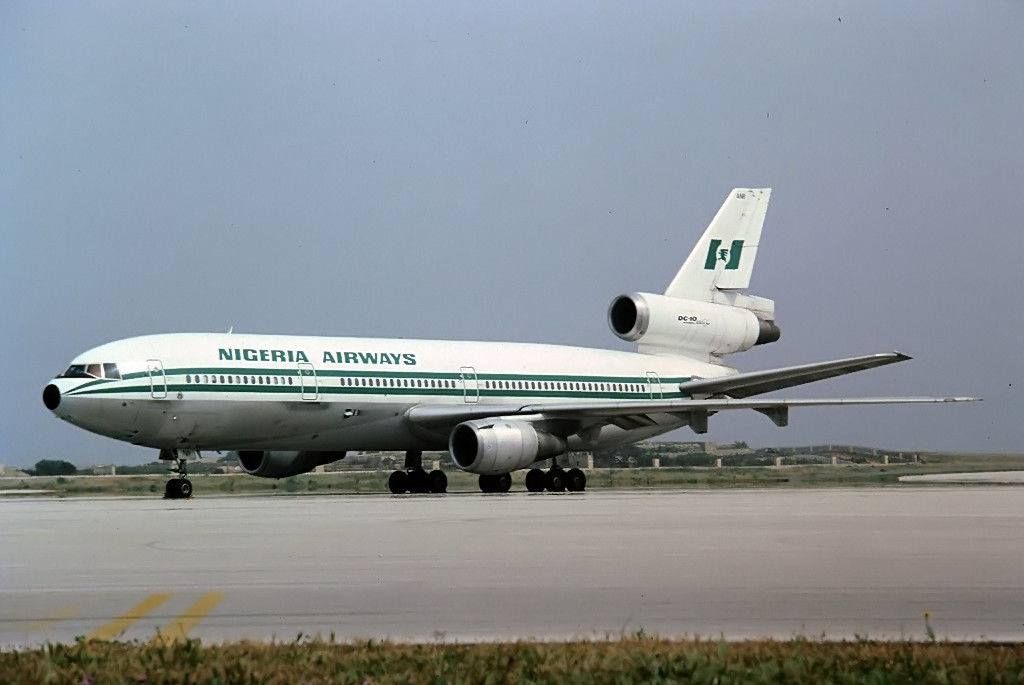
PHOTO: Captain August Okpe is type rated on Douglas DC10-30 Intercontinental Jet Airliner of Nigeria Airways.
Question: In your long flying career, you recorded over 15,000 hours. Was there any major incident worth mentioning?
Answer: I readily recall one of my passengers dying on board while we were enroute to London. The deceased was accompanied by a medical doctor because he was in pretty bad shape. We were halfway when the air hostess reported the sad development to me. Under international aviation protocol, if a passenger dies in transit, he is deemed to have died in the country of his intended destination where a medical doctor should pronounce him dead. The first port of call where he is pronounced dead by a doctor is deemed his country of death. The same law applies when a baby is born on board. The first country where the aircraft lands is said to be the place of birth. It is for this reason that air hostesses are well trained in midwifery.
Question: Your book titled “The Last Flight” is the only air war literature on that war written by a combat pilot. Do we look forward to another best seller from Captain August Okpe?
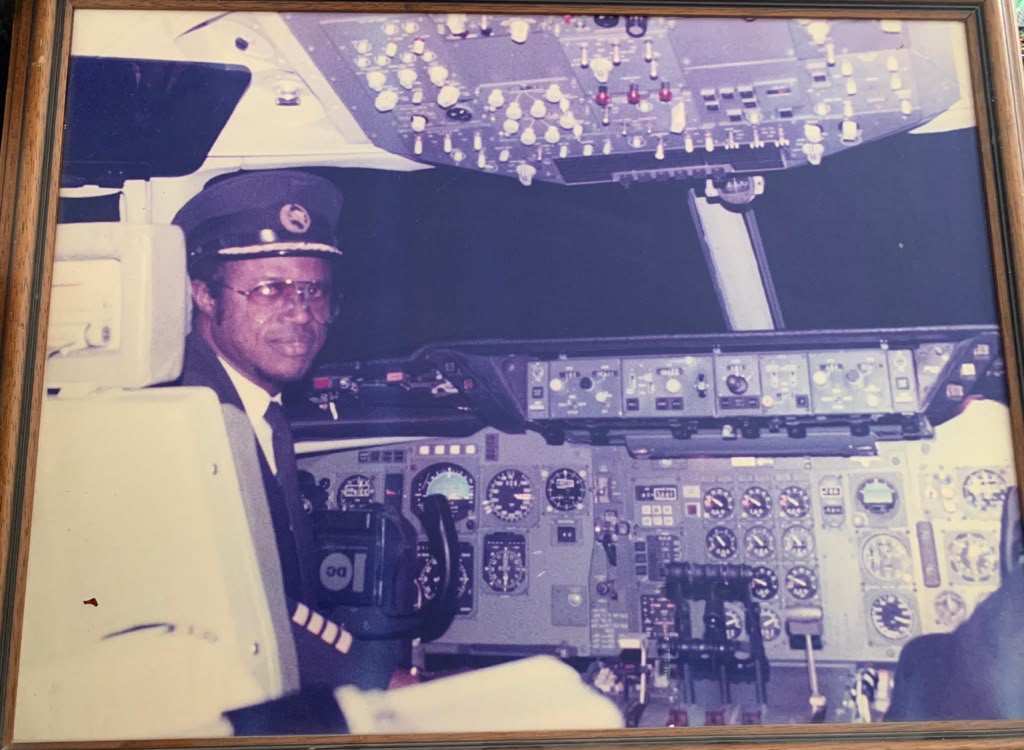
PHOTO: Captain August Okpe in the cockpit of Nigeria Airways Jet Airliner.
Answer: Sure. My next book is titled “After the Last Flight;” to hit the book stands mid-2027. It is a fine work that captures my experience as an airline captain. Rather than bombs and rockets, the work brings you into contact with amazing passengers from all walks of life.
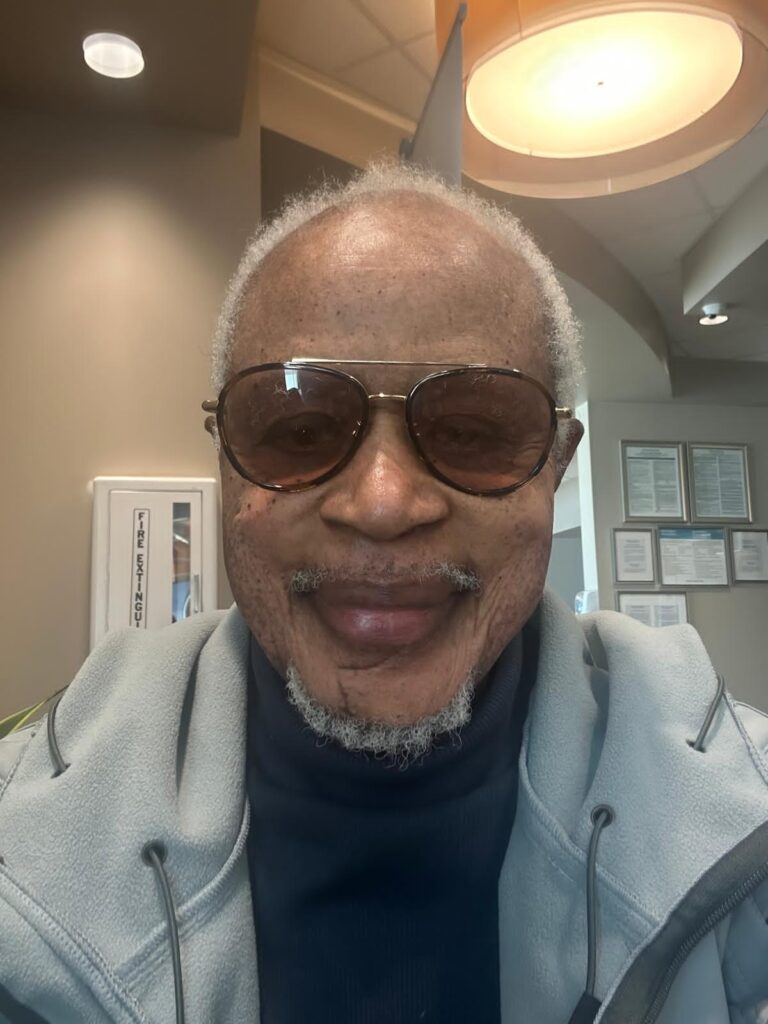
PHOTO: Captain August Okpe’s current photo, Houston, the US, 2026.
Being Part 3 of Series Honouring Captain August Okpe on his Forthcoming Birthday on August 18, 2026. Eke, Phone: +234 81 3515 9313; Email: chigachieke@yahoo.co.uk; writes from Port Harcourt, Rivers State, Nigeria.
Disclaimer: Candid Reporters publishes news, information, sports, opinions, and Interviews. The site includes both reported and edited content. Unmoderated posts and Comments expressed here do not reflect the opinions of Candid Reporters or any employee thereof..
